Showing posts with label mulch. Show all posts

Thursday, May 8, 2014

Of Nuts & Mice


  How could I resist? Road crews that had been trimming trees along power lines were finishing up work almost right in front of my house with a whole truckload of wood chips. Spreading chips had not been on my “to do” list; now it was, right after the crew graciously dumped contents of the truck in a space between my chestnut trees.

Chestnuts are trees of the forest. Mine, like many of those deliberately planted, have grass at their feet. The wood chips, I reasoned, would make the ground more home-like for the trees. Forest soils are typically overlaid with a layer of organic (that is, living or once living) materials: fallen leaves, twigs, limbs. These organic materials rot, in the process releasing nutrients as well as putting nutrients already in the soil in forms more readily accessible to plants. The organic feast encourages fungi, bacteria, and other soil life, all of which generally keep insect pests and diseases at bay.

In addition to nutritional and biological goodness, any organic material also brings physical goodness. Rainwater more easily percolates into the ground and, once within, the water is retained by the spongy, decomposed organic matter. At the same time, soil aeration is improved. It’s the best of of both worlds: more moisture plus more air at root level. No wonder I couldn’t resist.

People sometimes ask if I care what kind of chips I am getting. The answer is “no.” People sometimes ask if I’m worried about termites in the chips. Again, “no.” Termites require intact wood for their tunnels. What about “nitrogen tie-up,” which temporarily starves plants for nitrogen when high-carbon materials, such as wood chips, are added to the soil and microorganisms, which are better at garnering soil nitrogen than are plants, go to work. Again, I’m not concerned. Nitrogen tie-up only occurs if chips are mixed INTO the soil, promoting rapid decomposition.

Some people believe in using gourmet chips, also known as ramial chips, which means , according to chip aficionadas, wood chips made from branches no larger than 2-3/4 inches in diameter, and preferably from deciduous trees. So before I had my load of chips dumped I had the road crew climb into their truck to separate out the good from the bad chips -- just kidding! There’s not much, actually nothing at all, to support chip aficionadas’ claims. I’ll take and took any and all chips.

Come autumn, perhaps I’ll round out the soil diet with a load of leaves.

------------------------------------------------
I am a big fan of black walnuts. Last autumn’s harvest has been cracked, shelled and squirreled away to enjoy in the months ahead. The latest buzz on black walnuts, though, is about their sap, which reputedly boils down into a tasty syrup, similar to maple syrup.

Almost all parts of walnut trees contain a compound, juglone, that is toxic or growth-stunting to many types of plants. This makes me wary about ingesting the sap, especially after it has been concentrated into a syrup.

Still, curiosity got the upper hand so I put a tap into a black walnut tree a few weeks ago, gathered sap, and then boiled it down into a syrup of similar consistency to maple syrup.

My report: Very good flavor, slightly different from maple sugar, perhaps with a hint of black walnut flavoring. (The latter could be my imagination.) And I’m still alive.

------------------------------------------------
One of the last legacies of winter are the “bare ankles” at the bases of some trees and shrubs. Bare because they have no bark.

Those bare ankles are the handiwork of mice. Snuggled beneath the snow, warm and safe from aerial predators, mice could munch away to their heart’s content on bark. The problem is that the bark layer is where nutrients and water are conducted up from the roots and down from the leaves.

Stripped stems will likely die, which could mean death for the whole plant if it’s a tree, it’s young, and it was weak. Or if it’s a species that does not sprout readily when cut back. Otherwise, new sprouts will grow from below the stripped region. If the plant is a tree, the most vigorous of the new sprouts can be trained as a new trunk. If the plant is a shrub, new sprouts will fill in.

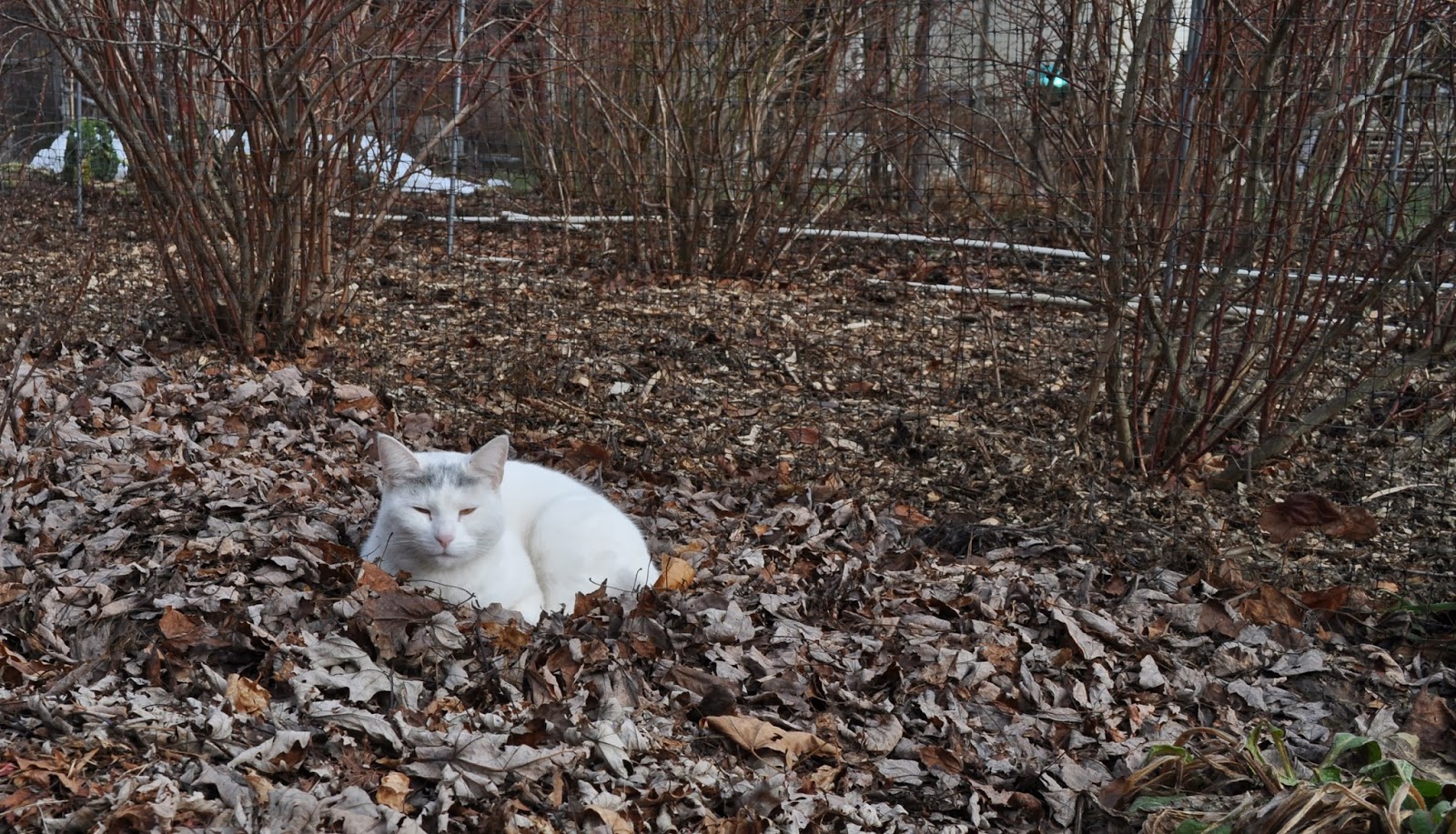
No need to sit back and bemoan the damage. Bridge grafting, whereby lengths of stem are grafted below and above the stripped area, will repair damage. And a good cat will avert it in the first place.

Thursday, December 19, 2013

Mulchercising with a Cat


I’m getting a lot of mulchercise here at the farmden these days. It’s good for me and good for the ground and, in turn, my plants.

Four piles of materials await me: a pile each of new and old wood chips, and a pile each of new and old leaves. The new pile of leaves is going to sit out this year’s mulchercise sessions. After a winter of settling and some decomposition, that pile will be just right for being planted with squash and melon plants. The lanky vines can run wild over the pile through summer and then, next year at this time, I’ll spread the much-reduced pile.

Last year’s leaf pile, from which I harvested this year’s squashes and melons, is part of my present mulchercise. The now dark brown material is getting hauled over to and spread beneath currant bushes, over the asparagus and flower beds, and on ground that will be home, next spring, to a new bed of Fallgold raspberries.

On to the wood chips . . . the old pile? That’ll go beneath various trees.

It’s amazing how simply spreading organic materials on top of the ground can bring so many benefits. Physically, that fluffy layer cushions the impact of raindrops so that moisture can percolate slowly into the
Me on the "abs & bicep" machine
ground rather than pound the surface, sealing it, and running off to make gullies. Mulch also insulates the ground, modulating swings in temperature to keep roots and other soil denizens happier. Next summer, the mulch will slow evaporation of water from the soil.

Biologically, mulch is food fungi, bacteria, and other soil organisms, the lion’s share of which are beneficial. As the leaves and wood chips go through cycles of being digested and excreted, what’s eventually left is humus, a witch’s brew of beneficial, organic compounds, which, in turn, is tied to nutritional benefits to plants. During decomposition, nutrients gathered up into leaves and wood are released into the soil, for plant use. Organic acids released during decomposition further nourish plants by dissolving additional nutrients from the rock matrix in which the soil was formed. And finally, organic chelates in humus grab onto some nutrients to render them more readily accessible to roots.

--------------------------------------------
I didn’t forget to mention my new wood chip pile; that mulch is getting carted over to blueberry heaven, heaven for the blueberries, that is. (Also for me, during summer’s harvest.)
Each autumn, right after blueberry’s leaves drop, I spread 10 to 20 pounds of soybean meal over the thousand square feet of planted area, then top it with a fresh layer of wood chips (this year) or leaves or
George is company, but not much help

wood shavings. Some years I also spread sulfur pellets over the ground to maintain the soil acidity that blueberry plants require. Not that often, though, because another benefit of an organic mulch is that it buffers changes in soil acidity, offering plenty of wiggle room in what range keeps the plants happy. The mulch also buries any berries infected with “mummy berry” disease, a problem I never have because the mulch layer prevents any spores that might be present from wafting upward to re-infect berries next year.

Blueberry bushes have shallow root systems, most roots descending less than a foot deep, with no root hairs. Thirty years with 2 to 3 inches of organic mulch laid atop the ground has created a soft, moist, heavenly environment for blueberry roots.

----------------------------------------------
I can just picture some readers “raising their hands” to point out that adding fresh, low nitrogen, organic materials to the soil results in nitrogen starvation of the plants. This science-y, oft repeated (and printed) myth needs debunking.

Soil bacteria and fungi need to eat both nitrogen and carbon. Wood chips and leaves are high in carbon
Me on the  “quads and aerobic machine"
but low in nitrogen, so these microorganisms grab at any other nitrogen in the ground to eat along with their fresh chips or leaves. Bacteria and fungi are better at garnering soil nitrogen than are plants, so plants are starved for nitrogen. Only temporarily, though, until some of the digested carbon is given off as carbon dioxide and what’s left are the higher nitrogen dead remains and excreta of bacteria and fungi.

When fresh chips or leaves are used as mulch, decomposition proceeds very slowly at the interface of soil and mulch. So slowly that nitrogen is re-released into the ground at about the rate it’s being tied up. Digging chips or leaves into the soil will definitely cause a temporary tie-up of nitrogen; mulching with these materials will not.

----------------------------------------------
So here at the Springtown Farmden Health Spa, I am mulchercising away. I start at the “abs and bicep machine,” rolling what looks like a garden cart
Me on the “rotary torso machine”
over to the mulch pile and then using what looks like a pitchfork to load leaves or chips onto the cart. Then it’s on to the “quads and aerobic machine,” whence I pull what looks like a cart full of leaves or chips over to some plants in need of mulch. Next, it’s the “rotary torso machine,” which looks like I’m scooping leaves or chips from the cart, twisting around, and then dumping it beneath a plant. Finally, back to the “abs and bicep machine,” for another rep. I should be able to get a dozen or so reps in before the mulch freezes solid for the winter.

Thursday, October 10, 2013

A Scything I Do Go . . .


What a lucky gardener I am to have a one-acre field at my disposal. Not for planting, though. Except part of it; I couldn’t restrain myself.

When I moved here, many years ago, the caretakers of the field -- before it was mine --mowed it every couple of weeks all summer long. Before them, another neighbor had mowed the field once a year with a sickle bar mower attached to his tractor. Nowadays, I mow the bulk of the field once a year with my tractor’s
brush hog attachment, which is, in essence, a giant rotary motor. But I mow the edges and a significant portion of the field by hand, with a scythe.

(Stay tuned for a scything video posted on my "Life on the Farmden" video series; link to the series above, to the right.)

So what’s so lucky about having this not-so-care-free field to take care of? Four things. First, the field offers a bit of wildness near my cultivated plants, a place where bees, dragonflies, and butterflies can frolic. Not that they can’t frolic among my cultivated plants, but there’s something to be said for what goes on among plants and soil hardly touched by human hand. Of course, rabbits, voles, and other undesirables come with the territory; I have to accept them.

The second lucky thing about having this field is all the mown vegetation it provides. Mowings from the brush hog are not easily gathered, but that from my scythe is. Laid on the ground beneath my trees, shrubs, and vines, this vegetation provides mulch that keeps the soil moist and feeds soil microorganisms and plants. Stuffed into my compost bins, the vegetation is nutritious food for my compost “pet” (pile).

That scything is also good for me, for the exercise. What a joy to step out in the coolness of morning and swing the scythe, stirring my “blood and [flexing my] muscles, while it clears the meadows," to quote Scott Nearing, who lived to be 100. That’s lucky thing number three.

Lucky thing number four is that I get to enjoy the beauty of the field, now dominated by yellow heads of goldenrod. Livening things up are spots of white asters against a shifting green background of grasses. And then there are patches dark green with thorny blackberry canes or red with leaves of sumac.

-------------------------------------------------------------
Ah, that sumac and those blackberries. They are the next step in the field’s transition from a meadow of herbaceous plants to woody shrubs, and then on to trees. That’s what happens if Nature’s given a free hand around here.

But I want a meadow. Not only that, but I notice that the ground beneath the tall goldenrod plants is quite bare of other vegetation.

So I’ve taken matters into my own hands, and am now scything down some of the goldenrod and any
areas dense with blackberry canes or sumac shoots. Exposed to light, the near-naked ground should soon be dense with sprouting grasses. By selectively scything those cleared areas repeatedly next spring, grasses can regain a toehold. Grasses are the only plants that tolerate frequent mowing.

A balance needs to be struck here. Too much mowing, and only grasses will persist. I’m trying for a mix of grasses with some goldenrod and other flowering meadow plants.

--------------------------------------------------------------
With a nod to sustainability, the question arises: In mowing the field and removing the mowings for compost and mulch, am I robbing Peter to pay Paul? As nutrients are carted off along with the vegetation, will the field yield less and less over the years. My guess is not.

Only a small portion of the total field gets scythed and harvested. And I scythe and harvest different areas each year. Soils have natural abilities to regenerate themselves when left alone. Nutrients locked up in
native minerals are unlocked over time as those minerals are solubilized by microbes and root exudates.

Even nitrogen, the nutrient that plants need in greatest amounts, can be grabbed from the air (which is 80% nitrogen) and put into a form that plants can use. Leguminous plants do this with the aid of symbiotic bacteria, but soils also contain free-living bacteria and other microorganisms that can grab at the nitrogen in the air to put in the ground.

So, all in all, the field presents a win-win situation, for me, for my plants, and for all the creatures, microscopic and larger, that get to enjoy it.