Showing posts with label blueberries. Show all posts

Thursday, December 19, 2013

Mulchercising with a Cat


I’m getting a lot of mulchercise here at the farmden these days. It’s good for me and good for the ground and, in turn, my plants.

Four piles of materials await me: a pile each of new and old wood chips, and a pile each of new and old leaves. The new pile of leaves is going to sit out this year’s mulchercise sessions. After a winter of settling and some decomposition, that pile will be just right for being planted with squash and melon plants. The lanky vines can run wild over the pile through summer and then, next year at this time, I’ll spread the much-reduced pile.

Last year’s leaf pile, from which I harvested this year’s squashes and melons, is part of my present mulchercise. The now dark brown material is getting hauled over to and spread beneath currant bushes, over the asparagus and flower beds, and on ground that will be home, next spring, to a new bed of Fallgold raspberries.

On to the wood chips . . . the old pile? That’ll go beneath various trees.

It’s amazing how simply spreading organic materials on top of the ground can bring so many benefits. Physically, that fluffy layer cushions the impact of raindrops so that moisture can percolate slowly into the
Me on the "abs & bicep" machine
ground rather than pound the surface, sealing it, and running off to make gullies. Mulch also insulates the ground, modulating swings in temperature to keep roots and other soil denizens happier. Next summer, the mulch will slow evaporation of water from the soil.

Biologically, mulch is food fungi, bacteria, and other soil organisms, the lion’s share of which are beneficial. As the leaves and wood chips go through cycles of being digested and excreted, what’s eventually left is humus, a witch’s brew of beneficial, organic compounds, which, in turn, is tied to nutritional benefits to plants. During decomposition, nutrients gathered up into leaves and wood are released into the soil, for plant use. Organic acids released during decomposition further nourish plants by dissolving additional nutrients from the rock matrix in which the soil was formed. And finally, organic chelates in humus grab onto some nutrients to render them more readily accessible to roots.

--------------------------------------------
I didn’t forget to mention my new wood chip pile; that mulch is getting carted over to blueberry heaven, heaven for the blueberries, that is. (Also for me, during summer’s harvest.)
Each autumn, right after blueberry’s leaves drop, I spread 10 to 20 pounds of soybean meal over the thousand square feet of planted area, then top it with a fresh layer of wood chips (this year) or leaves or
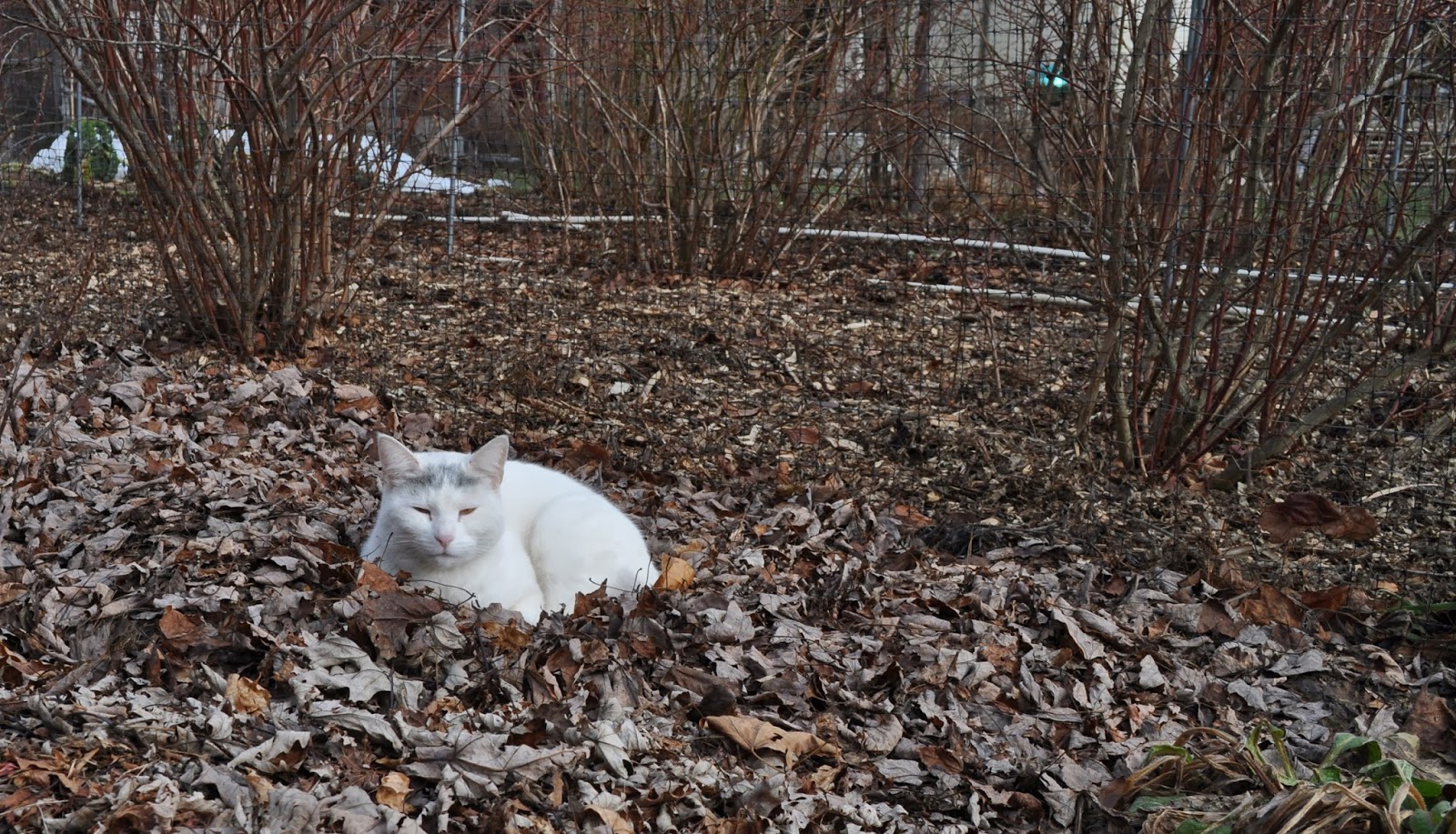
George is company, but not much help

wood shavings. Some years I also spread sulfur pellets over the ground to maintain the soil acidity that blueberry plants require. Not that often, though, because another benefit of an organic mulch is that it buffers changes in soil acidity, offering plenty of wiggle room in what range keeps the plants happy. The mulch also buries any berries infected with “mummy berry” disease, a problem I never have because the mulch layer prevents any spores that might be present from wafting upward to re-infect berries next year.

Blueberry bushes have shallow root systems, most roots descending less than a foot deep, with no root hairs. Thirty years with 2 to 3 inches of organic mulch laid atop the ground has created a soft, moist, heavenly environment for blueberry roots.

----------------------------------------------
I can just picture some readers “raising their hands” to point out that adding fresh, low nitrogen, organic materials to the soil results in nitrogen starvation of the plants. This science-y, oft repeated (and printed) myth needs debunking.

Soil bacteria and fungi need to eat both nitrogen and carbon. Wood chips and leaves are high in carbon
Me on the  “quads and aerobic machine"
but low in nitrogen, so these microorganisms grab at any other nitrogen in the ground to eat along with their fresh chips or leaves. Bacteria and fungi are better at garnering soil nitrogen than are plants, so plants are starved for nitrogen. Only temporarily, though, until some of the digested carbon is given off as carbon dioxide and what’s left are the higher nitrogen dead remains and excreta of bacteria and fungi.

When fresh chips or leaves are used as mulch, decomposition proceeds very slowly at the interface of soil and mulch. So slowly that nitrogen is re-released into the ground at about the rate it’s being tied up. Digging chips or leaves into the soil will definitely cause a temporary tie-up of nitrogen; mulching with these materials will not.

----------------------------------------------
So here at the Springtown Farmden Health Spa, I am mulchercising away. I start at the “abs and bicep machine,” rolling what looks like a garden cart
Me on the “rotary torso machine”
over to the mulch pile and then using what looks like a pitchfork to load leaves or chips onto the cart. Then it’s on to the “quads and aerobic machine,” whence I pull what looks like a cart full of leaves or chips over to some plants in need of mulch. Next, it’s the “rotary torso machine,” which looks like I’m scooping leaves or chips from the cart, twisting around, and then dumping it beneath a plant. Finally, back to the “abs and bicep machine,” for another rep. I should be able to get a dozen or so reps in before the mulch freezes solid for the winter.

Thursday, July 11, 2013

Blueberries & Cicadas, Mmmmm


“It takes a patient man to net an acre of blueberries.” The New England accent added weight to the declaration, as did the gentleman’s 80-something year old frame standing ramrod-straight and adorned with checkered jacket, a cap, and chinstrap beard. That was 30 years ago, and I was standing in the New Hampshire garden of Elwyn Meader, looking across the field at his acre of blueberries. Elwyn was a plant
breeder extraordinaire, then retired, who had developed new varieties of such plants as persimmons, chestnuts, lilacs, cucumbers, soybeans, watermelons, and everbearing strawberries. The honey-sweet Fallgold raspberry, my favorite, was Elwyn’s handiwork, incorporating genes from Korean raspberries he found while working there for the U. S. Army. 

Now, many years later, I think of Elwyn’s words as Deb and I rush to net our small plot, two-hundredths of an acre, of blueberries. (Not so small, though, to obviate a very respectable harvest of about 190 quarts of delectable, organic, sustainable, artisanal berries from 16 plants!) I append Elwyn’s words with “Covering two-hundredths of an acre of blueberries is a test of a marriage.” Nets can sag; tempers can thin; ladders can become unwieldy.

We survived. My latest incarnation of blueberry protection against birds starts with an enclosure of locust posts about 8 feet apart, with rebar running through holes a few inches from their tops. The sides, as my friend Bill calls it, my “Blueberry Temple,” are enclosed permanently in heavy duty, plastic bird netting (www.bennersgardens.com). Eighteen-inch-high chicken wire at the bottom keeps rabbits from chewing through the plastic. 

Now for the seasonal net, the one that tests our marriage and covers the planting while berries are
ripening, from late June until September. This net is of woven nylon, so is sturdy and drapes well (available from such sources as www.raintreenursery.com, www.jacissel.net, www.nylonnet.com). We spread the rolled up net on the ground near the entrance to the planting, then, each of us climbing a ladder at either side, lifts the roll up across the top, with either end of the roll resting on opposite sides of the rebar. Letting the free end drape a little over the entrance side, we each use a binder clip to fix the beginning of the roll near the entrance side. From then on, it’s a matter of unrolling the netting over the top, clipping and moving ladders as we go and -- this is the part
that can get testy -- making sure to keep the net even on both sides and sufficiently taught.

This year, the net was up in less than a half-hour, the blueberries were safe from birds, and the marriage was still intact.

------------------------------------------
Pruning tomatoes is such a pleasant garden “chore.” As I look over each plant for suckers -- any shoot that originates at the upper part of juncture between a leaf and main stem -- I get to monitor the swelling fruits, do a health check on the leaves and stems, and admire the plants’ neat growth habit. The latter comes from my weekly pruning off of the suckers followed by tying of the main stems to adjacent bamboo poles.

I can appreciate disorder in the garden but I also appreciate order. Disorder lends a pleasant, loosey-goosey atmosphere to the landscape. I find order more calming and an easier environment in which to satisfy the needs of each plant. For the tomatoes, pruning and staking them -- which surely puts them in order -- also gives greater yields (per square foot of garden space), and fruits that are cleaner and a bit earlier.

All this orderliness crumbles as August fades into September. By then, errant suckers get the best of me and the ever-elongating main stems reach the tops of their bamboo supports. Then where can they go? Sideways? Down? To an adjacent pole? No matter. By then, the end of tomato season is in sight and the plants pretty much do what they will as long as they keep pumping out juicy, red orbs.

------------------------------------------
The novelty of cicadas has worn thin. Their electronic cacophony whines in various pitches throughout the day without a moment’s respite. If you saw me walking past any one of my many infested trees or shrubs, you might see my arms flailing about to keep airborne ones at bay.

Thankfully, cicadas aren’t feeding on any plants. But their egg laying, beneath slits they make in bark, can cause damage. Young stems dying back do little damage to established trees and shrubs (gratuitous summer pruning of shoots?), but can kill young plants.

Here, the cicadas favor the lilac bush and pear trees and, to a lesser extent, the apple trees. I’ve gotten pretty good at snatching them by their wings. My chickens are very fond of the fresh, less so the frozen, catch of the day. This hand to hand combat feels good but makes but a small dent in the population.

The other afternoon I could no longer stand the sight of so many cicadas clustered on the trunks of my 8-year-old pear trees. I needed a bulk method, so ran indoors to grab a dust broom. The dust broom was quite effective, sending cicadas flying everywhere. And then back onto the trunks.

My last resort was to get out my sprayer and coat the trees and any resident cicadas with ‘Surround’, a commercially available,
organically approved pesticide made from kaolin clay. The coating makes for unpleasant footing and egg-laying for a variety of insects, and it clogs their spiracles.

The ‘Surround’, which I applied only to the apples and pears, had but little effect on the cicadas. Cicadas on plants became statuesque; a few fewer flew back on, for awhile. Of course, the incessant cacophony emanating from the woods continued. Only a couple of weeks or so to go, and then a 17 year hiatus.