Showing posts with label pear. Show all posts

Wednesday, November 27, 2013

A Seedy Time of Year

Around here, eating fruit isn’t always just about eating fruit. Following my last bite of this Macoun apple I’m eating, I flick out the seeds with a paring knife into a cup. Same goes for pears and their seeds. Early in summer, I spit out Nanking cherry seeds into a waiting vessel. All these seeds are for planting,

Seeds of these cold hardy plants won’t sprout as soon as they hit moist, warm dirt. If they did, the young seedlings would be snuffed out by winter cold. It is after a period of exposure to cool, moist conditions that they -- thinking winter over -- sprout. Seeds in dropping fruits, of course, enjoy this experience naturally and poke up through the ground first thing next spring,

Wanting to keep a close eye on my seedlings, I plant them in pots and seed flats rather than let them do what they would do naturally. After I had collected the seeds, I kept them dry, and now am ready to plant
them. This week I am sowing the seeds in potting soil in flats and in pots. Once given a good watering, the seed flats and pots get covered with a pane of glass to hold in moisture. Tucked against the north wall of my house, the seeds will sprout in spring,

Sometimes I cozy such seeds into plastic bags of moist potting soil in the refrigerator. The problem is that the seeds then  sprout in the bags in midwinter. Cool, not cold, temperatures are what fool the seeds into behaving as if winter’s over. About 1,000 hours, depending on the species and variety of plant, usually does the trick. In the refrigerator, temperatures are always cool; outdoors, only sometimes, and there, it’s not until late winter that the required 1,000 hours of cool temperatures have been fulfilled. It’s hard to provide ample light for an enthusiastic seedling growing in midwinter,

---------------------------------------------
Unless a plant self-pollinates and has been grown in isolation, with desirable plants selected each generation for many generations, seedlings are unlike their parents. So none of the fruits on the seedlings that grow from the seeds taken from Macoun, Golden Delicious, Liberty, Bosc, Maxine, and Clapp’s Favorite apples and pears will match the parents; they will most likely be inferior,

No problem; these seedlings are for rootstocks on which to graft stems of good-tasting varieties of apples and pears. Rootstocks are ready to graft after growing for one season,

Nanking cherries are an exception; no varieties are available. The seedlings, which show some variation, are all good-tasting, so no need anyway to graft,

----------------------------------------------
Another batch of seeds I’m sowing is of more tropical-like plants: passionfruit and hardy orange. I write
“tropical-like” because the passionfruit I’m planting is maypop (Passiflora incarnata) and the hardy orange is Poncirus trifoliata. Both should survive winter cold here. Both are also northern members of tropical or subtropical families, and their seed behavior reflects their tropical “roots.”

Hardy orange seeds, like citrus seeds, lose their viability if allowed to dry out. Things are not so clearcut with the best way to grow maypop from seed. I sowed the seeds as soon as I removed the delectable, gel coating each seed (by eating it),

--------------------------------------------
Hardy orange is a nice ornamental plant; my hardy orange is the variety Flying Dragon, which is a spectacular ornamental plant,

In contrast to apple and pear seedlings, hardy orange seedlings often resemble their moms. Seeds of hardy orange, like those of citrus, look like any old seeds that result from the union of male pollen with
female eggs. In fact, many are apomyctic, that is, derived solely from mother plant tissue. No jumbling around of chromosomes to produce variable seedlings here. Apomyctic seedlings are clones, Flying Dragon in the case of my hardy orange seedlings,

A citrus or hardy orange fruit yields some apomyctic and some sexual seedlings, about 50% of each in the case of hardy orange,

As I admired Flying Dragon over the past few months, one way or another I had to make more plants. Cuttings taken a few months ago weren’t rooting and although the plant flowered, no fruits were evident. Then, last week, as leaves dropped from my plant -- hardy orange parts ways with real oranges in being deciduous -- I caught sight of a single orange orb perched on a stem. One fruit is plenty because they are very seedy. That single fruit, smaller than a golf ball, yielded 20 seeds,

I didn’t eat any of that Flying Dragon fruit. A bit of juice from hardy orange adds a citrus-y tang to a recipe but the fruit itself is too robust and bitter for eating straight up,


Thursday, August 29, 2013

Plums and Pears


New video now up: See www.youtube.com/leereichfarmden.

-------------------------------------
Whoosh! Summer is speeding past. Cicadas have come and gone. Same goes for Japanese beetles. Temperatures have cooled dramatically.

And now it’s raining plums. That’s a good thing, and something not easily achieved in this part of the world without, at least, some sprays. The main threats come from plum curculio, Oriental fruit moth, black knot, and brown knot. The first and the last are my most serious plum pests, curculio causing young fruits to plummet to the ground early in the season and brown rot turning nearly ripe fruit into masses of gray fuzz.

Although a few early season sprays, the last in June, knocked out many curculios and reduced inoculum for later infections of brown rot, pruning is all-important in my arsenal against pests. In late winter, I clipped off or partially back enough branches so that remaining ones would be bathed in light and air for quick drying
-- and less diseases -- following rain or dew. While pruning, I also kept my eyes out for any thick, tarry coatings (black knot) or dark, sunken areas (valsa canker) on stems; such stems got lopped back 6 inches into healthy wood.

I do all this every year and some years I still get no plums; this year, as I wrote, it’s raining plums. Raining??!! Yes. That’s because we harvest daily by giving branches a slight shake, which brings ripe plums raining down. Once we’ve gathered the good drops into a basket and infested and infected ones into a compost bucket, the chickens move in to clean up any missed drops, which also helps keep pests in check.

The variety is Imperial Épineuse, which originated in France about 1870 and made it stateside in 1883. It’s a prune plum, so can also be dried. The fresh flavor is so good that I’m more than willing to accept a crop 2 out of every 5 years.

A certain amount of luck is involved, especially here, in getting a plum crop because my site is less than ideal as far as temperatures and humidity. I credit this past spring’s perfect temperatures for my current luscious harvest. Fingers crossed for next year.

----------------------------------------
As I was harvesting the first pears of the season (also a very nice crop this year, thank you) -- the variety Harrow Delight -- I noticed a lot of columbine plants colonizing the mulched ground beneath the pear trees. As a matter of fact, columbine and an occasional thistle are the main weeds there. These columbines aren’t our dainty, native columbines but, rather, hybrids of cultivated columbines. They’re not flowering now, but the robust leaves are telling.

My columbines aren’t necessarily weeds. They started out as cultivated hybrids that I planted many years ago. Year after year of cross-pollination has jumbled the genes to create new hybrids, natural ones. They’re somewhat different from the originals and from each other but I’ve never seen one that wasn’t attractive. The flowers are long past, of course, having morphed into dry seed heads that rattle down seeds every time I brush them, sowing more plants. The whorl of leaves are still green and lush with the delicate look of maidenhair fern.

At some point, the number of columbines tips the scales into weediness. Some, I see, have the audacity to be edging their way into the vegetable garden. My plan is to maintain a fluid and, hopefully, not too tenuous balance between columbine-the-flower and columbine-the-weed. I can’t imagine ever having to plant columbine again.

----------------------------------------
Looking up from the columbines, I continue to pick pears -- not an easy job. The difficulty comes from trying to figure out when to do it. Pears must be harvested underripe because they ripen from the inside outward. Allowed to fully ripen on the tree, their insides become brown mush. The fruit must, however, be sufficiently along on the road to maturity before harvest if it is to ripen well.

A few clues help tell when to pick: A lightening of the skin’s background color; the raised pores on the skin becoming brown and corky; the stalk separating easily from the stem when the fruit is lifted and twisted. These changes are subtle and require judgement. Last year I harvested too late so this year I’m scrapping judgement and picking by calendar date gleaned from various sources after taking into account their locations.

The story doesn’t end with harvest, though. Before the early pears are ready to eat, they need a few days refrigeration. (Outdoor temperatures are sufficiently cool to chill late-ripening pears.) After that, small batches can be sequentially taken from the refrigerator to finish ripening at  room temperature. A short window, then, presents itself when flavor is at its best. “There are only 10 minutes in the life of a pear when it is perfect to eat,” wrote Ralph Waldo Emerson. But what a sensuous 10 minutes.

Friday, April 6, 2012

A new book: Grow Fruit Naturally, pear excerpt


Now is a good time to plan and plant for some home-grown fruits -- pears, for example. Here’s an excerpt from the pear section of my NEW book, Grow Fruit Naturally (Taunton Press, 2012, signed copies available from my website, listed at right):
My 'Yoinashi' Asian pear, now in bloom
Pears come in two “flavors:” European and Asian. European pears, which are most familiar in American markets, are typically buttery, sweet, and richly aromatic -- and pear-shaped. Asian pears are typically round with crisp flesh that, when you take a bite, explode in your mouth with juice. Their flavors are sweet with a delicate, floral aroma and sometimes a hint of walnut or butterscotch. Both kinds of pears have been cultivated for thousands of years, and within each type exists thousands of varieties.
Pears of either “flavor” are easy to grow. But growing and ripening a European pear to its highest state of perfection is an art. The best one I ever tasted was at a horticultural conference at the venerable East Malling Research Station in England. At the conclusion of the conference we were led into an elegant, large, wood-paneled room, up the center of which ran a hulking, oak banquet table on which sat nothing more than a few bowls of perfectly ripened ‘Comice’ pears, ours for the tasting. I reached for a pear, took a bite, and quickly had to make my way to the conveniently opened French doors at the far end of the room to keep the ambrosial juice dripping with each bite from marring the staid surroundings.
---------------------------------------------------------
Cultivation of European and Asian pears is essentially the same, with just a few subtle differences. Both need full sun and soil that is at least reasonably well-drained. Pears can tolerate wetter soils than many other tree fruits. Among my favorite varieties are ‘Magness’ and ‘Seckel’ European pears, and ‘Yoinashi’ and ‘Chojuro’ Asian pears.
A pear spur
Once a tree reaches bearing age, prune lightly every year. Completely remove some  of the overly vigorous stems, which mostly originate higher in the tree, and merely shorten weak twigs, which mostly arise lower in the tree. Fruits are borne on spurs, which are short stems elongating only a half-inch each year. Periodically, shorten old branches more aggressively to stimulate growth of new shoots and spurs. Asian pears need more aggressive pruning than European pears, although European pears, especially, are prone to growing many overly vigorous, vertical growing shoots, which shade the plant, are not fruitful, and are more prone to disease. Cut them back when pruning or, even better, grab them in your hand and rip them off with a quick downward jerk while they are still green and growing during summer.
Each flower bud on a pear tree opens to a cluster of flowers, so pear trees, left to their own devices, usually will overbear. Thin fruits to about 5 in. apart. Thinning Asian pears is very important, spelling the difference between a harvest of ho-hum pears and ones that elicit a “wow!”
---------------------------------------------------
In most yards, pears can be grown successfully without any attention to pest control. Occasionally, a few pests warrant attention and action.
The main bugaboo in pear growing is the bacterial disease fire blight, readily identified by stems whose ends curl in shepherd’s crooks with seemingly singed, blackened leaves still attached. Diligent pruning out of blighted stems, cutting a few inches below damage, keeps the disease in check. Fire blight has never appeared on any of my more than a dozen trees.
-----------------------------------------------
Now for the reward: harvest. Asian pears are precocious, sometimes fruiting in their third season, while European pears are slower to come into bearing. 
First, the easy harvest. Asian pears. Harvest them when they are fully colored and detach easily when you roll them upward with a twist. Taste is the final test: If flavor is not up to snuff, let the fruits hang longer.
European pears must be harvested underripe. Left to fully ripen on the tree, the flesh is brown mush. The fruit must, however, be mature before it is picked and the first clue to fruit maturity is a subtle lightening of the skin’s background color. Look more closely, at the lenticels, or raised pores on the skin; they will become brown and corky at harvest time. Lift and twist the fruit. If the stalk separates easily from the stem, the fruits are ready for harvest.
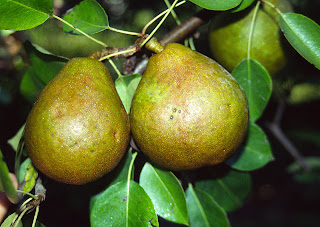
'Magness' pear - mmmm, one of the best!
You’re not yet in pear heaven. European pears need to be kept cool for awhile -- a few days for early ripening varieties, a few weeks for late ripening varieties -- before they can begin ripening. Keep them cool longer if you intend to store them.
Take some pears out of cold storage a few days before you want them for eating and put them in a cool room. They are ready to enjoy when they give slightly with pressure from your finger near the stem end. If you’ve mastered the art of pear growing, harvesting, and ripening, your reward is fruits that are neither “sleepy” nor the other extreme, “grassy,” but juicy and sweet with characteristic aromas that might include varying proportions of almond, rose, honey, and musk. Still, to quote Ralph Waldo Emerson, “There are only ten minutes in the life of a pear when it is perfect to eat.” But what sensuous ten minutes!
--------------------------------------------------
Perry is fermented pear juice, an old-fashioned beverage whose origin lies in France but reached its heyday in 16th and 17th century England. The juice was not your mother’s – or grandmother’s – pear juice. Pears for perry, a different species from European or Asian pears, are mostly too astringent for fresh eating. They’re also very long-lived: an avenue of perry pears planted in England in 1710 were reportedly still alive and fruitful in the mid-20th century. 
Perry is made like hard cider, except that perry pears need to sit for a few days after harvest for their flavors to develop. And again, after crushing, the pomace needs to sit for about a day to reduce the tannins. The end product is quite different from cider because perry pears have more fermentable and nonfermentable sugars, more citric acid, and different kinds of tannins. And because, of course, the raw material is pears.
Traditionally, perry has been a very variable product, reflecting what varieties of perry pears went into the mix, how the mix was fermented, how the fruits were grown, and the vagaries of a particular season. The drink was very much a home- or farm-made beverage, varying as much in alcohol concentration as in flavor. After experiencing a lapse in interest and various attempts to industrialize the product in the 20th century, perry is undergoing a renaissance.
Part of that renaissance lies in the re-discovery of some of the traditional perry pear varieties. ‘Arlingham Squash’, ‘Green Horse’, ‘Moorcroft’, ‘Rock’, and ‘Taynton Squash’ are among the varieties that have contributed to vintage quality perries for over three centuries. One problem with these old varieties is that their nomenclature is as muddled as the finished product can be in some years. Hundred of names exist for a much less number of varieties. Which isn’t all bad, because some of those names are worth having just because: ‘Mumblehead’, ‘Merrylegs’, ‘Devildrink’, ‘Lumberskull’, and, the longest one on record, ‘A drop of that which hangs over the wall’.
--------------------------------------------
Two gardening workshops in the offing:
On April 22nd, I’ll be hold ing a pruning workshop, covering the why, when, with what, and how of pruning.
On April 28th, I’ll be holding a grafting workshop, covering the how, why, and when of grafting. In addition to a hands-on demonstration, participants will graft and take home their own pear tree.
Both workshops will be held at my “farmden,” run from 2-5:50 pm, and cost $55. Pre-registration is necessary. For information or registration, contact me at garden@leereich dot com.