Showing posts with label potting soil. Show all posts

Thursday, February 13, 2014

The Season Begins

Gentlemen (and ladies, and kids), start your engines. The 2014 gardening season has begun, here on the farmden, at least.

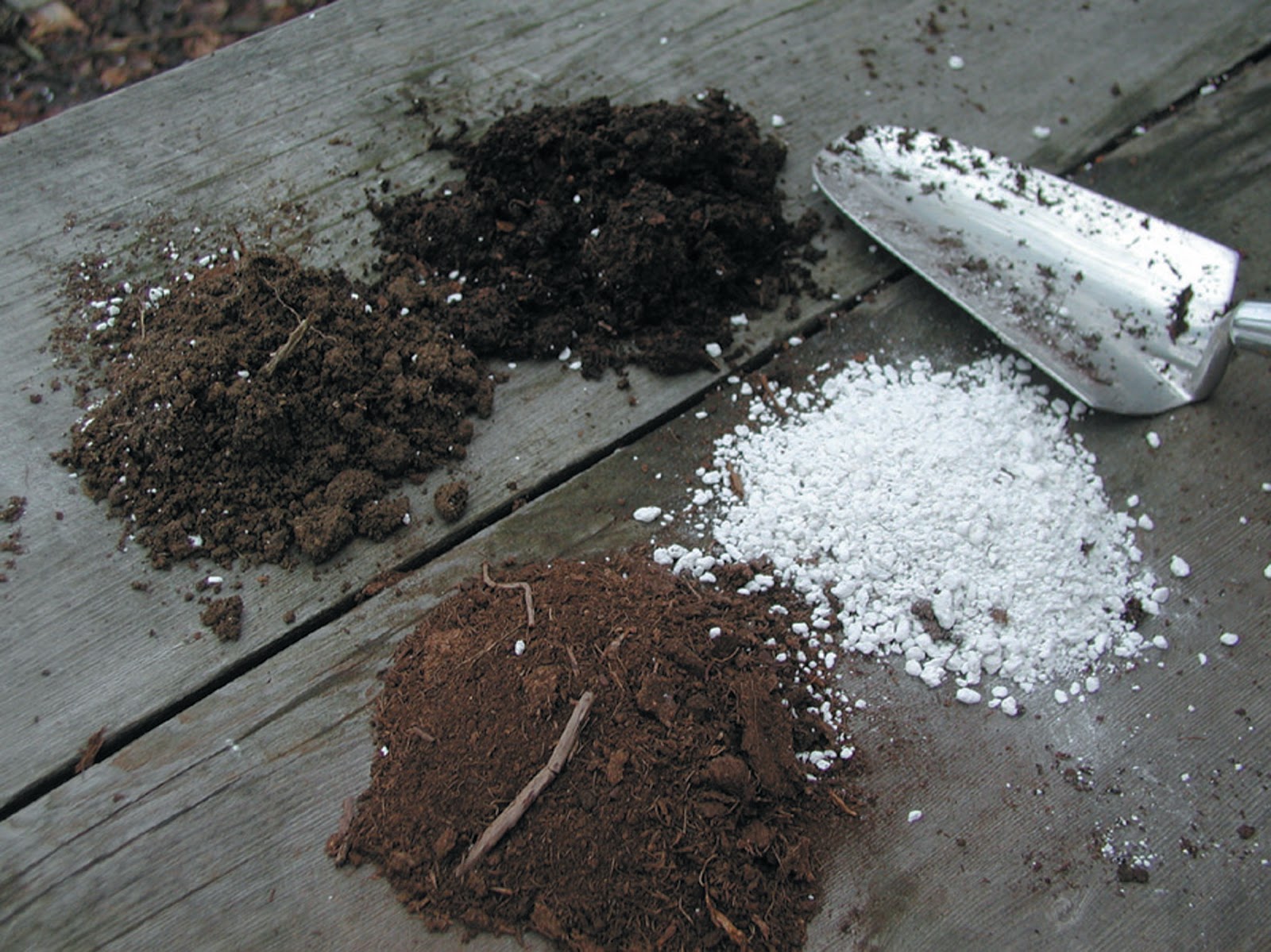
The day began with my lugging the big pail of potting soil from the cold garage to a warm spot near the woodstove. My home-made potting soil -- equal parts peat, compost, garden soil, and perlite, with some soybean meal thrown in -- is moist when I make it, so was frozen solid. Not usable or suitable for germinating seeds.

Once the potting soil defrosts and warms, I scoop it into a seed flat and a small plastic tub into which I’ve drilled drainage holes. Firming the soil in place with my Furrow Maker, a small board with spaced out,
The Furrow Maker in action
1/4-inch dowels glued to its underbelly, creates a miniature farm field. Into the tub’s “field” go rows of fresh onion and leek seeds (fresh is important with these seeds, which lose viability after a year or two), about 7 seeds per inch, which is enough to well populate the “field” without causing crowding. After the seeds are covered with soil and gently and thoroughly watered, the tub gets covered with a pane of glass and placed on a heating mat that provides gentle warmth of between 70 and 80 degrees F.

I could sow onion seeds outdoors in early spring. The onions I’m growing, and the ones all northern gardeners should be growing, are so-called long day (in fact, short night) varieties. Their leaf growth comes screeching to a stop in early summer’s 15 or
16 hour days. The plants shift gears and redirect their energy into pumping up growing bulbs. More leaves at that time means more stored energy available to swell up sweet, juicy bulbs. That’s what I want and why I go through the trouble(?) of early, indoor sowing. I’ll plant out the seedlings in early May.

The small seed flat gets similarly filled with potting soil and sown with seeds, lettuce seeds in this case. Greenhouse lettuce is still going strong but I want to have some transplants ready for when the older stuff peters out. A 4 by 6 inch flat with four furrows of lettuce seeds should provide all the lettuce transplants I need for many weeks.

------------------------------------------------
A greenhouse full of only lettuce could get boring. Other sorts of edible greenery currently share the space, and will continue to do so in the coming weeks. Some has been planted, and some has planted itself.

Among the planted greenery is a whole bed of kale and Swiss chard livened up with a couple of fennel plants. Also mâche, which usually plants itself except that overly diligent weeding in the greenhouse
Fennel, chard, lettuce, and kale in this bed
necessitated transplanting self-sown mâche from outdoor garden beds into the greenhouse last September.

Self-sown greenery includes claytonia (miner’s lettuce), minutina, and -- more familiar to most people -- celery. Claytonia doesn’t have much flavor but adds texture and color to a winter salad. The same goes for minutina, which is actually an edible species of plantain (the common lawn weed, not the banana relative). Celery plants are in various stages of growth. We’ve been eating the mature ones for months and the smallest seedlings will be ready for transplanting out into the garden in early May.

------------------------------------------------
So my friend Bob is over for a visit. It’s near lunchtime and he beelines for the freshly baked loaf
Celery for eating and celery babies for transplanting
of bread sitting innocently on the kitchen counter. Bob grabs a knife and already has a sandwich in mind. “Do you have any tomatoes,” he says. What? Tomatoes? It’s midwinter!

I guess he’s made the link gardening-greenhouse-tomatoes. Never mind winter. Sorry, not in my greenhouse in winter, for a few reasons.

Fruiting demands a lot of a plant’s energy. That energy comes from the sunlight. Even though the sun has been rising higher in the sky and for longer periods daily, its light is still paltry compared to midsummer sunlight. A bright summer day bathes the garden with about 10,000 foot-candles of light. My greenhouse, according to measurements taken at high noon on this crystal clear day, is bathed  with about 6,400 foot-candles of sunlight.

Natural sunlight could be supplemented with artificial light. Not a table lamp or even a bank of fluorescents, though. Light intensity falls off as the inverse square of distance from the light source; double the distance and you’ve got only one-quarter the intensity. So plants need to be close to the light source, which then will shade natural sunlight. Special high intensity bulbs are needed to make a dent in winter’s relative darkness.

And then there’s the temperature needed to raise a crop of tomatoes in February. For tomatoes, I wouldn’t want temperatures lower than in the 50s. My greenhouse heater kicks on at 37°F. Each degree of warming increases heating costs about three percent.

Winter tomatoes don’t seem worth the extra cost in dollars and to the environment from increased usage of gas or electricity. And they don’t taste that good. I can wait.

Friday, December 21, 2012

A Jump on Spring


I got a jump on spring yesterday and started pruning hardy kiwifruit vines. The fruit is a kissing cousin of fuzzy, market kiwis, except, with smooth skins and small size, they can be popped whole in your mouth like grapes. Hardy kiwis are also cold-hardy, which their cousins are not.

The vines need yearly pruning to let light and air in among the stems for productivity and plant health, to keep fruiting stems within easy reach, and to stimulate new stem growth each year off which grow fruiting shoots the following year.

My plants are trained on 5 wires strung between T-trellises, one wire down the middle of the trellis flanked by 2 wires on either side of that central wire. Each plant’s trunk rises up to the middle wire and then divides into two cordons, or permanent arms, that run in opposite directions along the middle wire. Fruiting arms, which are 1-year-old stems, grow off perpendicularly to the cordon to drape down over the outside wires.

As I approached the vines with shears, lopper, and small saw in hand, the vines looked back at me like an intimidating, tangled mess. Three steps in pruning brought everything in order. I first cut back all fruiting arms to within a foot or so of the outside wire and shortened each cordon back to where it began growth last year. Arms bear fruiting shoots near their bases so don’t need the whole of their lanky stems. As to the cordons, if they were allowed to grow longer and longer, one plant would tangle into the next plant down the row.

Next, the hardest part: I reached into the remaining tangle to cut back fruiting arms that have, over the years, begun to originate further and further off the cordons. These got shortened so that new shoots, for fruit 2 years hence, would originate closer in to the cordons. Left to their own devices, as they are in the wild on the edges of Asian forests, the vines would be climbing 100 ft. high on anything on which they could grab hold.

Finally, I thinned out most of the remaining fruiting arms so that they are about a foot apart. I’ll do a final pruning in spring, thinning more where needed and shortening all fruiting arms to their final length of about 18 inches long.

I’m left now with a pile of prunings. Their intertwining stems make nice decoration. I could also save some for my cat. Kiwi stems have a pleasing effect on the cats, similar to catnip. In Asian zoos, they have been used to calm “large cats.”
-------------------------------------------------
What joy a mere sprout can foreshadow! Late last summer a gardening friend gave me some sprouts from her Maid of Orléans jasmine (Jasminum sambac). By the end of summer, a few of the cuttings had rooted and even flowered.  The plant or its flower wouldn’t win (or lose) any beauty contests, but is well worth growing for its unabashed fragrance. The aroma is sweet and rich and not at all cloying, even after the flowers fade.

What’s more, this jasmine flowers freely. As a matter of fact, it just finished its second round of flowering. Contrast this behavior with my two plants of common jasmine (Jasminium officinale). These latter plants occasionally cough forth a few flowers in late winter but nothing like the profusion of white blossoms they once did. I’ve tried everything, from starting new plants from cuttings to pinching shoots all summer until August to keeping them cool in until late winter to keeping them dryish until late winter to keeping them cool and dryish until late winter to keeping them in the greenhouse to . . .  you get the picture.

The only dark cloud hovering over my Maid of Orleans was the potting mix. Something seemed not quite right with it, having me worried that the plant might not grow or, worse, expire (as did the plant from the gardening friend from whom I got the cuttings). Not that this is a time of year to expect growth from any plant.

But now, that cloud has moved on. The new sprout looks happy and healthy and foretells of a fragrant future.
-------------------------------------------------

I mixed up a new batch of potting soil, which I’ll need anyway in a couple of months for indoor sowing of the first seeds of next season. Into a 5 gallon bucket went finished compost and soil, equal parts, sifted. Into another 5 gallon bucket went peat moss and perlite, equal parts, sifted. I tipped the contents of both buckets together into the garden cart, sprinkled on 1 cup of soybean meal and a handful of kelp, and repeatedly slid a flat-bladed shovel under the pile and turned it over and over. Once everything was thoroughly mixed, I shook and forced it again through the 1/2-inch sieve and packed it away into buckets.

This potting mix will be home to the roots of seedlings and houseplants, as well as large, potted fig trees, roses, and pomegranates. Also, to Maid of Orleans, as soon as she outgrows her present quarters.

Thursday, May 10, 2012

A Reel Mower, Potting Soils


Coming out of the gate of the warmest and driest winter in decades, weather this spring has been a roller coaster ride. March had a spate of sunny days in the 70s, then temperatures plummeted to the low 20s, then the dry spell was ended with some rain, and recently temperatures have continued on the seasonably cool and cold side. Lawngrass has enjoyed the weather, and during one of the recent calms I finally got the opportunity to roll out the lawnmower.


The opportunity!? Mowing the lawn isn’t usually one of my favorite pastimes but this spring I was anxious to try out my new lawnmower. No need to clean and tighten the sparkplug, check the gas and oil, and pray for  the roar of exploding gasoline (within the engine) with this new mower. It’s a push mower, “push” as in your pushing gets it moving and turns the front reel that lops grass cleanly as the sharp blades rotate pass the fixed bar.


Push mowers have come a long way since those heavy, iron monsters of yore and my new Fiskars Reel Mower was a joy to use. So much s that I was able to do a “Tom Sawyer” on my visiting brother and his two daughters, letting them vie to see who gets to create that musical whirring of the gears accompanied by a broad fountain of grass blades flying up and out in front of the traveling mower. (He ordered one for himself when he got home.)


Using a push mower is more than just fun, of course. It’s good for the environment. A gasoline powered lawnmower pollutes as much in an hour as a car driving 250 miles; pollution from electric corded or battery powered mowers depends on how the electricity is generated. A push mower offers the opportunity for productive exercise. And reel mowers make cleaner cuts than rotary mowers so result in a healthier lawn. I highly recommend Fiskars Reel Mower.
--------------------------------------------
A few weeks ago I fingered possible blame for poor seed germination and poor seedling growth on my having substituted peat moss for coir in my potting mix. Coir is a sustainable byproduct of coconut processing; peat moss takes eons to form so is not sustainable.


I’m happy to report that I was wrong. My seeding failures, it turns out, were due to the heating pad that is meant to provide gentle bottom heat for seed germination in my cool temperature greenhouse. Instead of the desired 75°F., the thermostat for that heating pad had been inadvertently turned up to 100°F (probably by me)!


Gardening brings into play the interaction of all sorts of physical, chemical, and biological system; the interactions are complex and this complexity makes it hard to ascribe cause and effect. But gardeners too often do this, just as I did (with reservations) relating coir in my potting mix to poor seed germination and seedling growth. 


To really find out if “A” causes “B,” (for instance, that coir is bad for seed germination) you have to control as many variables as possible (same seeds, same light, same watering, etc.) and then apply “A” to only half of your plants. It’s often not all that easy to control other variables. And anyway, if you start out believing that something -- compost tea, for example -- is going to make your plants grow better, you’ll be wont to not use it on all your plants. And then, if the summer happens to be sunny and warm with timely rains, you still might be inclined to tout that something -- the compost tea, in this example -- for good growth.
-----------------------------------------------------------


My coir blunder did have the benefit of making me more objective about what makes a good potting soil. Many years ago, after much research, I came up with my own not-secret potting soil recipe of equal parts compost, garden soil, peat, and perlite with some soybean meal and kelp thrown in for extra nitrogen and micronutrients. Coir, in my last mix, substituted for all the peat.

After thinking that coir ruined my mix, I made up a batch of potting soil using 3 parts leaf mold (thoroughly rotted leaves) with one part perlite, again with some soybean meal and kelp. And then I actually did an experiment, planting half my lettuce seedlings in the leaf mold mix and the other half in the coir mix. Once removed from the overheated heating pad, seedlings grew equally well in either potting mix.


Which is to say, with reference to religions or potting soils: Many roads lead to the mountaintop. A good potting mix needs to drain well, hold moisture, provide nutrients, and provide a biologically friendly environment for roots. Perlite, sand or vermiculite can provide good drainage. Compost, peat, coir, or leaf mold help hold moisture and provide a biologically friendly root environment. Soil, compost, leaf mold, soybean meal, and kelp can provide nutrients. Various combinations of these ingredients make equally good potting mixes.