Showing posts with label coir. Show all posts

Thursday, May 10, 2012

A Reel Mower, Potting Soils


Coming out of the gate of the warmest and driest winter in decades, weather this spring has been a roller coaster ride. March had a spate of sunny days in the 70s, then temperatures plummeted to the low 20s, then the dry spell was ended with some rain, and recently temperatures have continued on the seasonably cool and cold side. Lawngrass has enjoyed the weather, and during one of the recent calms I finally got the opportunity to roll out the lawnmower.


The opportunity!? Mowing the lawn isn’t usually one of my favorite pastimes but this spring I was anxious to try out my new lawnmower. No need to clean and tighten the sparkplug, check the gas and oil, and pray for  the roar of exploding gasoline (within the engine) with this new mower. It’s a push mower, “push” as in your pushing gets it moving and turns the front reel that lops grass cleanly as the sharp blades rotate pass the fixed bar.


Push mowers have come a long way since those heavy, iron monsters of yore and my new Fiskars Reel Mower was a joy to use. So much s that I was able to do a “Tom Sawyer” on my visiting brother and his two daughters, letting them vie to see who gets to create that musical whirring of the gears accompanied by a broad fountain of grass blades flying up and out in front of the traveling mower. (He ordered one for himself when he got home.)


Using a push mower is more than just fun, of course. It’s good for the environment. A gasoline powered lawnmower pollutes as much in an hour as a car driving 250 miles; pollution from electric corded or battery powered mowers depends on how the electricity is generated. A push mower offers the opportunity for productive exercise. And reel mowers make cleaner cuts than rotary mowers so result in a healthier lawn. I highly recommend Fiskars Reel Mower.
--------------------------------------------
A few weeks ago I fingered possible blame for poor seed germination and poor seedling growth on my having substituted peat moss for coir in my potting mix. Coir is a sustainable byproduct of coconut processing; peat moss takes eons to form so is not sustainable.


I’m happy to report that I was wrong. My seeding failures, it turns out, were due to the heating pad that is meant to provide gentle bottom heat for seed germination in my cool temperature greenhouse. Instead of the desired 75°F., the thermostat for that heating pad had been inadvertently turned up to 100°F (probably by me)!


Gardening brings into play the interaction of all sorts of physical, chemical, and biological system; the interactions are complex and this complexity makes it hard to ascribe cause and effect. But gardeners too often do this, just as I did (with reservations) relating coir in my potting mix to poor seed germination and seedling growth. 


To really find out if “A” causes “B,” (for instance, that coir is bad for seed germination) you have to control as many variables as possible (same seeds, same light, same watering, etc.) and then apply “A” to only half of your plants. It’s often not all that easy to control other variables. And anyway, if you start out believing that something -- compost tea, for example -- is going to make your plants grow better, you’ll be wont to not use it on all your plants. And then, if the summer happens to be sunny and warm with timely rains, you still might be inclined to tout that something -- the compost tea, in this example -- for good growth.
-----------------------------------------------------------


My coir blunder did have the benefit of making me more objective about what makes a good potting soil. Many years ago, after much research, I came up with my own not-secret potting soil recipe of equal parts compost, garden soil, peat, and perlite with some soybean meal and kelp thrown in for extra nitrogen and micronutrients. Coir, in my last mix, substituted for all the peat.
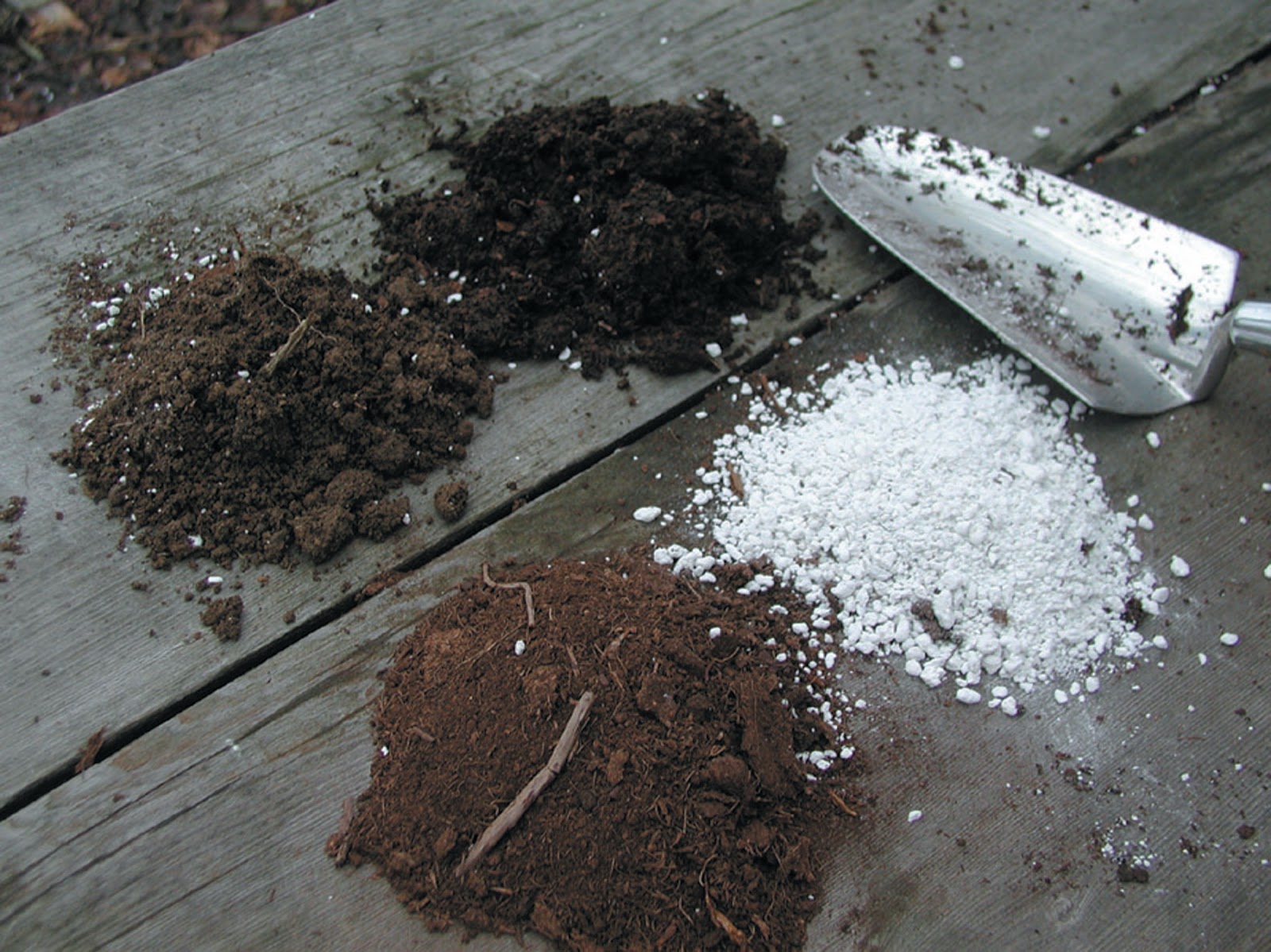
After thinking that coir ruined my mix, I made up a batch of potting soil using 3 parts leaf mold (thoroughly rotted leaves) with one part perlite, again with some soybean meal and kelp. And then I actually did an experiment, planting half my lettuce seedlings in the leaf mold mix and the other half in the coir mix. Once removed from the overheated heating pad, seedlings grew equally well in either potting mix.


Which is to say, with reference to religions or potting soils: Many roads lead to the mountaintop. A good potting mix needs to drain well, hold moisture, provide nutrients, and provide a biologically friendly environment for roots. Perlite, sand or vermiculite can provide good drainage. Compost, peat, coir, or leaf mold help hold moisture and provide a biologically friendly root environment. Soil, compost, leaf mold, soybean meal, and kelp can provide nutrients. Various combinations of these ingredients make equally good potting mixes.

Wednesday, March 21, 2012

Coir, A Substitute for Peat


My kitchen isn’t filled with the fragrance and beauty of blooming daffodils, and I have no one to blame but -- no, not myself, but -- the local store where I bought the bulb last autumn. How could I have resisted? Sitting right by the checkout counter of the store was a bucket full of bulbs, each bulb only one dollar and having the makings of fragrance and beauty already locked within.
Yes, “already locked within.” Spring bulbs’ flowers are initiated in the growing season before the flowers appear. The key to unlocking the pleasures lurking within most spring bulbs is cold temperatures. A period of cold weather lets these bulbs know that winter is over and it’s all right to awaken and blossom. Exposure to cold happens naturally outdoors, with the flowers appearing in spring. 
When “forcing” bulbs for early bloom, you trick the bulbs into thinking that winter is over by exposing them to the requisite amount of cold, which varies for different kinds of bulbs. Brought indoors in winter to warmer temperatures, they can then blossom out of season.
The bulb that I bought was a “paperwhite” daffodil, a species (Narcissus tazzeta) that originated in warmer regions of the western Asia. In those warm regions, paperwhites evolved to flower without needing to experience winter cold. So buy one of these bulbs in autumn, pot it up or put its base in water, and bingo, flowers soon appear.
Except for the paperwhite that I purchased. That bulb just kept growing leaves, an indication that last year’s growing conditions were not good enough -- insufficient light, fertility, or water perhaps -- for the bulb to divert energy into making a flower bud.
The present bulb is the second one I got from the same bin this past autumn. After the first one showed no sign of flowers, I went back to the store, explained why, as long as the bulb grows, it should make a flower, and received a second one free of charge. 
I figured the first bad bulb was an aberration. It wasn’t. I’ve been watching leaf after leaf unfurl on the second dud for weeks and weeks.
-------------------------------------------------------
In an effort to make my farmdening even more sustainable, I’m swearing off peat moss, or hoping to. Peat moss is the partially decomposed remains of plants, mostly sphagnum species. In the garden or farmden, peat moss is very useful for improving soil aeration, and water and nutrient retention. Mostly, these benefits are put to use in potting soils to help roots in their rather limited growing space. My home-made potting mix, which I’ve made for over 30 years, is 1/4 by volume peat moss (the other 1/4s comprised of garden soil, perlite, and compost, and a bit of soybean meal and kelp meal for added nutrients).
Use of peat is unsustainable because its mining outstrips its rate of formation. Peat accumulation can occur at a snail’s pace: an inch or so per thousand years. Peat develops under boggy conditions and to mine it, the bog must be first drained. Air replaces the water and the result is that some of the carbon stored in peat is oxidized to carbon dioxide. And we all know what that does. As a final blow to sustainability, draining and mining peat bogs upsets its unique ecological habitats.
So must gardening and farmdening, both potentially sustainable practices for providing local food that can to be grown with minimal environmental disruption, be wedded to the use of peat moss? Not necessarily.
Other organic materials, such as compost and leaf mold, can fulfill the same functions as peat moss in potting mixes. They have the further advantages of being local and richer in plant food than peat moss. They have the disadvantages that you have to make the stuff, that planning is needed because you have to gather the materials and wait for them to “cook,” and that the final product may not always be consistently the same.
---------------------------------------------------
A consistent, commercial peat substitute coming down the pike is coir, a renewable byproduct of coconut processing with characteristics very similar to peat moss. I’ve experimented occasionally with coir over the years and it seemed to work well enough. However, seedlings planted in a recent batch containing coir aren’t thriving.
Anytime a component of a potting mix is changed, changes might also be needed in watering regime or fertilization. My guess is that watering is the problem since my potting mix has plenty of nutrients from the compost and soybean meal, and the symptoms -- poor growth and leaves wrinkly but not off-color -- don’t indicate any nutrient deficiency. The symptoms seem more like those due to poor root growth, possibly from excessive moisture. Or perhaps the soil or compost had some weak root pathogen that’s getting the upper hand.
I need to sleuth out this problem soon because I’m about to make a large sowing of cabbage and its kin as well as peppers and eggplants. On the plus side, all this is some of what makes gardening so interesting.
--------------------------------------------------------------
Any gardening questions? Email them to me at garden@leereich.com and I'll try answering them directly or in this column. Come visit my garden at www.leereich.blogspot.com.