Thursday, January 2, 2014

Holly Needs Sex

LEE’S UPCOMING LECTURES/WORKSHOPS
•Jan. 9: Minnesota Nursery and Landscape Association, Minneapolis, MN, “Weedless Gardening”, “Luscious Landscaping, with Fruiting Trees, Shrubs, and Vines”
•Jan. 23: Long Island Horticultural Conference, Ronkonkoma, NY, “Pruning Shrubs”
•Jan. 25, Northeast Organic Farming Association of New York, Saratoga Springs, NY, “Growing Figs in Cold Climates”, “Espalier Fruits”
•Feb. 6, Indiana Museum of Art, Indianapolis, IN, “Multi-Dimensional Vegetable Growing”
•Feb. 15, Northeast Organic Farming Association of Vermont, Burlington, VT, 
“Grape Expectations: Everything From Choosing Varieties to Eating the Berries”, “Pruning Fruit Trees, Shrubs, and Vines”
•Feb. 20, Ontario Fruit and Vegetable Convention, Niagara Falls, CA, “Uncommon Fruits with Commercial Potential”
•March 1, Northeast Organic Farming Association of Connecticut, Danbury, CT, "Growing Figs in Cold Climates", "Multi-Dimensional Vegetable Gardening/ Farming"
•March 15, Connecticut Master Gardener Conference, Manchester, CT, “Fruits for Small Gardens”

AND NOW, ON TO HOLLY'S PROBLEMS

The problem is obvious: No sex. No sex, no berries. Oh, did I mention that I’m writing about hollies, my hollies? Now, after a number of years, the plants have grown lush with spiny, forest-green leaves. But no red berries.

A holly berry, like any other fruit, is a mature ovary, which is a home for a seed or seeds. Seeds are what stimulate development of a fruit, but seeds themselves usually can't get started without sex. Sex happens in plants when male pollen lands on the female part of a flower, called the stigma, and then grows a
pollen tube down the style, which is attached to the stigma, to reach and fertilize an egg. The product of successful pollination and fertilization is a seed, the development of which induces the surrounding floral part to swell to become a fruit.

Why all this concern with holly's sex life? After all, I don’t give sex a second thought when growing tomatoes. I plant whatever varieties I want and then reap plenty of swollen ovaries . . . er, fruits . . . as well as, incidentally, seeds.

Holly is special because its pollen is borne on flowers that are strictly male and its eggs are contained within flowers that are strictly female. Each tomato flower, in contrast, is botanically “perfect,” with both male and female parts, so can take care of itself, sexually speaking. Similarly self-sufficient are rose flowers, peach flowers, sunflowers, and the flowers of many other plants.

Holly is not alone in having single sex -- botanically, “imperfect” -- flowers. Many nut trees, for example, share this trait. But holly goes one step further sexually, with whole plants being either male or female, a trait shared by ash and persimmon trees, among others.

The long and the short of it is that I need an all-male holly tree or bush if I’m going to deck my halls with (berried) boughs of holly from my all-female holly tree or bush. A male plant, all leaves and no berries, is not as showy as a female, so it's fortunate that a single male can sire a half-dozen or so females.

Adding to their sex problems, or, rather, our problems with their sex life, hollies are not all that promiscuous. A few different species supply us with berried boughs -- notably American holly, English holly,
My sex-less hollies
and Meserve holly -- but, generally, each keeps fidelity to its own species. (An exception is that English holly can pollinate Meserve holly, which is a hybrid offspring of the English species.) Further compounding hollies' sex problems, some males within a species cannot even adequately pollinate some females within the same species because their bloom times do not overlap.

Breeders have come up with a number of virile male varieties whose genders are obvious from their names: Blue Prince and Blue Boy Meserve hollies, and Jersey Knight American holly are examples. These males, as you might guess, are particularly good mates for the varieties named, respectively, Blue Princess, Blue Girl, and Jersey Princess.

--------------------------------------------------------------
The hollies that I planted were Meserve hollies. I’m pretty sure that I planted a suitable male for my 5 females, with the male sufficiently close to do their thing with the females. So, why no berries?

One possibility is that my hollies had sex, but that late frosts caused fertilized flowers to abort. But every year? My hollies have never sported berries. One hundred percent frost damage every year is unlikely, and especially so this past spring.

The nursery could have mislabeled their plants. The only way to sex the plants is to peer closely at the small flowers early next May and look for those with male or female flower parts. I’ll do that.

--------------------------------------------------------------
Sex is no problem for my jasmine (Jasminium officinale) plant; its problem is sexuality. The plant lacks flowers, and flowers are all I ask for from this plant. This plant, commonly known as poet’s jasmine, is supposed to sport oodles of deliciously fragrant, starry, white blossoms about now. (Now that I think of it, perhaps the hollies have never flowered no flowers, no sex, no berries.)

Like amaryllis, Christmas cactus, and many other winter-flowering plants, poet’s jasmine initiates flower buds in response to changing conditions such as exist in late summer and early fall. To whit, shortening days,
My flowerless jasmine
cooler temperatures, and/or, in some regions, drier weather. I’ve tried them all with my poet’s jasmine, and every year about midwinter, buds begin growth on the plant that keep stretching out into lanky, twisting shoots that try to grab onto whatever they can twist around. But no sign of flowers or flower buds.


It’s time to threaten the plant. No flowers this winter and into the compost you go, my little jasmine. (I’ve also tried threatening in previous year, to no avail.) Any suggestions??

Thursday, December 26, 2013

Ugly, But Tasty, Old Fruit

Today’s fruit du jour is medlar (Mespilus germanica), one of the most-disgusting-looking fruits you could imagine. Don’t stop reading! Medlar was a popular fruit in the Middle Ages, and with good reason. Charlemagne was so taken by this fruit that he decreed that it be planted in every town he conquered. Medlar needs some contemporary pr.

Let’s get those bad looks out of the way. Picture a small apple with a rough, russeted skin and the calyx end -- the end opposite the stem -- flared open. Not very pretty, eh? That homely appearance gave rise to
some not-so-complimentary nicknames. “Open-arse” fruit, for example, by Chaucer. Or, from Shakespeare, more discretely, “open-etcetera.”

Ugliness, for medlars, is not just skin deep. When harvested, which was a few weeks ago here, the fruits are white and rock hard within, and not ready for eating. The fruit must be bletted, or ripened, a couple of weeks or more. I blet my medlars by setting them on the cool, north windowsill facing my kitchen sink. With the woodstove at full tilt, the air at the windowsill might still be too dry for best bletting, so I also have a few fruits bletting beneath a small bell jar in another cool part of the kitchen. A wrinkling, dark skin tells me that bletting is complete. At this point the flesh has experienced a dramatic transformation --  to brown mush.

I put all that ugliness behind me and taste that brown mush. Delicious! Something like very rich applesauce with hints of wine. I’ve only eaten them straight
up. They allegedly also cook up into delicious tarts, jellies, “fools,” and the like. Here’s a simple recipe for a tart, dating back to 1660, from Robert May’s The Accomplisht Cook: “Take medlars that are rotten, strain them, and set them on a chaffing dish of coals, season them with sugar, cinamon and ginger, put some yolks of eggs to them, let it boil a little, and lay it in a cut tart; being baked scrape on sugar.”

(For a once popular fruit, medlar has had its share of pejoratives. “Rotten,” in the above recipe, means bletted. But many fruits, including European pears and avocados, need to be harvested unripe to ripen off the plant. Admittedly, few are brown mush when ready to eat.)

--------------------------------------------------------------
So much for medlar’s bad looks and good flavor. Let’s take a good look at the plant itself.

Those ugly fruits ripen on a very attractive, small tree that never reaches more than about eight feet high or a spread of equal width. It’s a year ‘round beauty, even now, leafless, with its craggy branches and light brown bark. In spring, in contrast to many other fruit trees, the leaves unfold before the blossoms; each
blossom, opening singly and with white petals like a wild rose (a relative), is then framed by a whorled backdrop of forest-green leaves.

The tree is also self-pollinating, so does not need a companion to set fruit. Small size, beauty, and ability to perform solo make a medlar tree perfect for a small yard. One tree, then, doubles as your ornamental plant and your fruit tree.

-------------------------------------------------------------
Pests can be a big bugaboo when growing tree fruits. The best way to deal with pests is to avoid them, and the best way to avoid them is to grow kinds or varieties of fruits naturally resistant to pests. That’s one reason I suggest against growing apples pretty much anywhere east of the Rocky Mountains. (Two of apples most significant pests, plum curculio and apple maggot, are absent from many areas of the West.) Nectarines, peaches, apricots, and plums similarly suffer from serious insect and disease problems, again, especially east of the Rocky Mountains.

You may wonder, then: What’s left to grow? Pears, for one. Also, a slew of other tree fruits that are not well-known, fruits such as medlar, pawpaw, persimmon, cornelian cherry, raisin tree, mulberry, and Asian
Bletting medlars
pear.  These uncommon fruits all have excellent flavor and few or no pest problems (and play the leading roles in my book Uncommon Fruits for Every Garden). They also demand little expertise or time in pruning as compared with some of the common tree fruits.

Not that biting into a fresh-picked, good variety of well-grown apple or peach isn’t a heavenly experience. And not that the occasional tree of such fruits some years bears a decent crop without trouble. But it pays to play the averages and proceed with eyes wide open. What are the chances for a good harvest and how much effort (and learning) will be devoted to upping the odds?

Thursday, December 19, 2013

Mulchercising with a Cat


I’m getting a lot of mulchercise here at the farmden these days. It’s good for me and good for the ground and, in turn, my plants.

Four piles of materials await me: a pile each of new and old wood chips, and a pile each of new and old leaves. The new pile of leaves is going to sit out this year’s mulchercise sessions. After a winter of settling and some decomposition, that pile will be just right for being planted with squash and melon plants. The lanky vines can run wild over the pile through summer and then, next year at this time, I’ll spread the much-reduced pile.

Last year’s leaf pile, from which I harvested this year’s squashes and melons, is part of my present mulchercise. The now dark brown material is getting hauled over to and spread beneath currant bushes, over the asparagus and flower beds, and on ground that will be home, next spring, to a new bed of Fallgold raspberries.

On to the wood chips . . . the old pile? That’ll go beneath various trees.

It’s amazing how simply spreading organic materials on top of the ground can bring so many benefits. Physically, that fluffy layer cushions the impact of raindrops so that moisture can percolate slowly into the
Me on the "abs & bicep" machine
ground rather than pound the surface, sealing it, and running off to make gullies. Mulch also insulates the ground, modulating swings in temperature to keep roots and other soil denizens happier. Next summer, the mulch will slow evaporation of water from the soil.

Biologically, mulch is food fungi, bacteria, and other soil organisms, the lion’s share of which are beneficial. As the leaves and wood chips go through cycles of being digested and excreted, what’s eventually left is humus, a witch’s brew of beneficial, organic compounds, which, in turn, is tied to nutritional benefits to plants. During decomposition, nutrients gathered up into leaves and wood are released into the soil, for plant use. Organic acids released during decomposition further nourish plants by dissolving additional nutrients from the rock matrix in which the soil was formed. And finally, organic chelates in humus grab onto some nutrients to render them more readily accessible to roots.

--------------------------------------------
I didn’t forget to mention my new wood chip pile; that mulch is getting carted over to blueberry heaven, heaven for the blueberries, that is. (Also for me, during summer’s harvest.)
Each autumn, right after blueberry’s leaves drop, I spread 10 to 20 pounds of soybean meal over the thousand square feet of planted area, then top it with a fresh layer of wood chips (this year) or leaves or
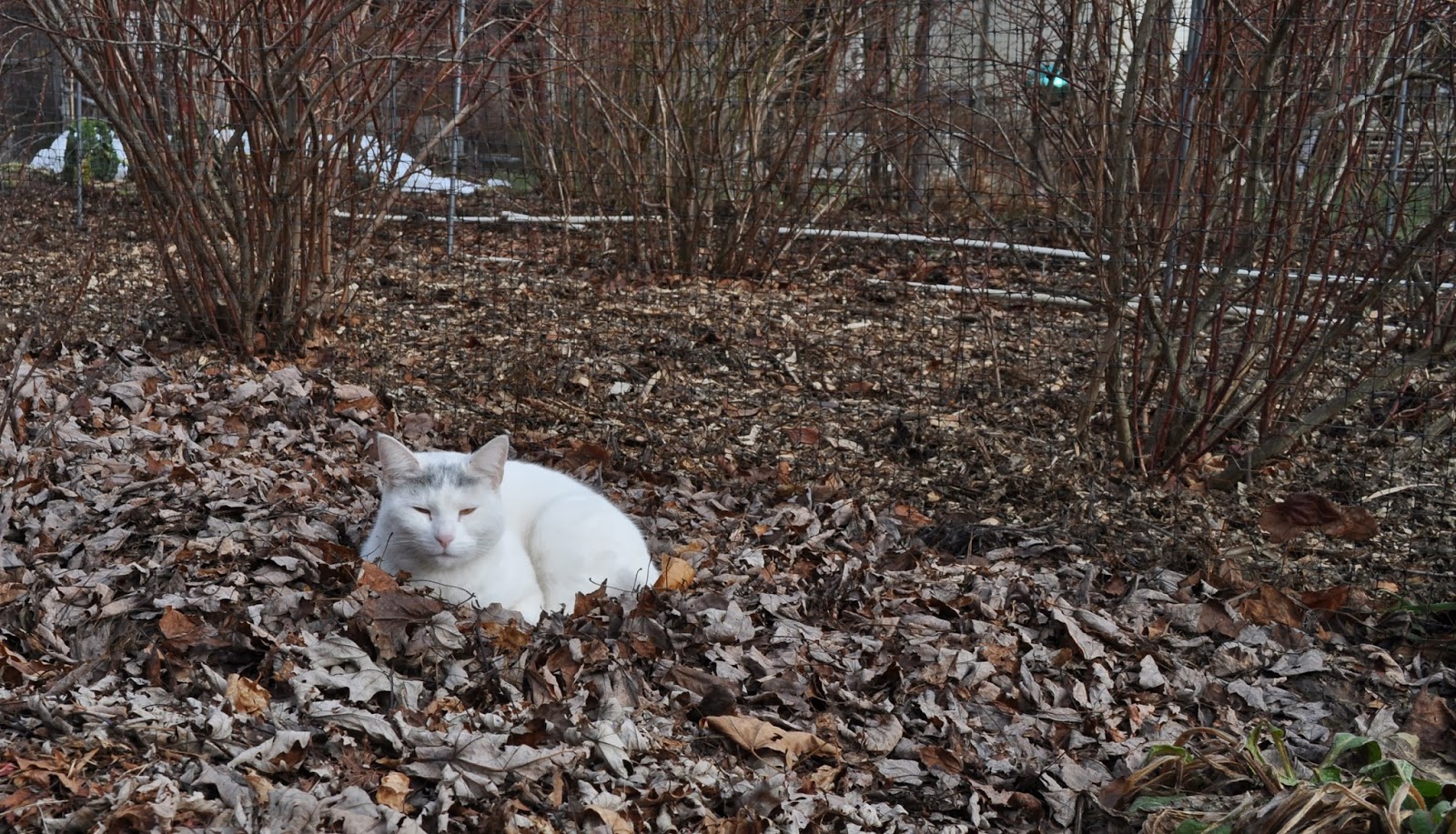
George is company, but not much help

wood shavings. Some years I also spread sulfur pellets over the ground to maintain the soil acidity that blueberry plants require. Not that often, though, because another benefit of an organic mulch is that it buffers changes in soil acidity, offering plenty of wiggle room in what range keeps the plants happy. The mulch also buries any berries infected with “mummy berry” disease, a problem I never have because the mulch layer prevents any spores that might be present from wafting upward to re-infect berries next year.

Blueberry bushes have shallow root systems, most roots descending less than a foot deep, with no root hairs. Thirty years with 2 to 3 inches of organic mulch laid atop the ground has created a soft, moist, heavenly environment for blueberry roots.

----------------------------------------------
I can just picture some readers “raising their hands” to point out that adding fresh, low nitrogen, organic materials to the soil results in nitrogen starvation of the plants. This science-y, oft repeated (and printed) myth needs debunking.

Soil bacteria and fungi need to eat both nitrogen and carbon. Wood chips and leaves are high in carbon
Me on the  “quads and aerobic machine"
but low in nitrogen, so these microorganisms grab at any other nitrogen in the ground to eat along with their fresh chips or leaves. Bacteria and fungi are better at garnering soil nitrogen than are plants, so plants are starved for nitrogen. Only temporarily, though, until some of the digested carbon is given off as carbon dioxide and what’s left are the higher nitrogen dead remains and excreta of bacteria and fungi.

When fresh chips or leaves are used as mulch, decomposition proceeds very slowly at the interface of soil and mulch. So slowly that nitrogen is re-released into the ground at about the rate it’s being tied up. Digging chips or leaves into the soil will definitely cause a temporary tie-up of nitrogen; mulching with these materials will not.

----------------------------------------------
So here at the Springtown Farmden Health Spa, I am mulchercising away. I start at the “abs and bicep machine,” rolling what looks like a garden cart
Me on the “rotary torso machine”
over to the mulch pile and then using what looks like a pitchfork to load leaves or chips onto the cart. Then it’s on to the “quads and aerobic machine,” whence I pull what looks like a cart full of leaves or chips over to some plants in need of mulch. Next, it’s the “rotary torso machine,” which looks like I’m scooping leaves or chips from the cart, twisting around, and then dumping it beneath a plant. Finally, back to the “abs and bicep machine,” for another rep. I should be able to get a dozen or so reps in before the mulch freezes solid for the winter.