Thursday, February 13, 2014

The Season Begins

Gentlemen (and ladies, and kids), start your engines. The 2014 gardening season has begun, here on the farmden, at least.

The day began with my lugging the big pail of potting soil from the cold garage to a warm spot near the woodstove. My home-made potting soil -- equal parts peat, compost, garden soil, and perlite, with some soybean meal thrown in -- is moist when I make it, so was frozen solid. Not usable or suitable for germinating seeds.

Once the potting soil defrosts and warms, I scoop it into a seed flat and a small plastic tub into which I’ve drilled drainage holes. Firming the soil in place with my Furrow Maker, a small board with spaced out,
The Furrow Maker in action
1/4-inch dowels glued to its underbelly, creates a miniature farm field. Into the tub’s “field” go rows of fresh onion and leek seeds (fresh is important with these seeds, which lose viability after a year or two), about 7 seeds per inch, which is enough to well populate the “field” without causing crowding. After the seeds are covered with soil and gently and thoroughly watered, the tub gets covered with a pane of glass and placed on a heating mat that provides gentle warmth of between 70 and 80 degrees F.

I could sow onion seeds outdoors in early spring. The onions I’m growing, and the ones all northern gardeners should be growing, are so-called long day (in fact, short night) varieties. Their leaf growth comes screeching to a stop in early summer’s 15 or
16 hour days. The plants shift gears and redirect their energy into pumping up growing bulbs. More leaves at that time means more stored energy available to swell up sweet, juicy bulbs. That’s what I want and why I go through the trouble(?) of early, indoor sowing. I’ll plant out the seedlings in early May.

The small seed flat gets similarly filled with potting soil and sown with seeds, lettuce seeds in this case. Greenhouse lettuce is still going strong but I want to have some transplants ready for when the older stuff peters out. A 4 by 6 inch flat with four furrows of lettuce seeds should provide all the lettuce transplants I need for many weeks.

------------------------------------------------
A greenhouse full of only lettuce could get boring. Other sorts of edible greenery currently share the space, and will continue to do so in the coming weeks. Some has been planted, and some has planted itself.

Among the planted greenery is a whole bed of kale and Swiss chard livened up with a couple of fennel plants. Also mâche, which usually plants itself except that overly diligent weeding in the greenhouse
Fennel, chard, lettuce, and kale in this bed
necessitated transplanting self-sown mâche from outdoor garden beds into the greenhouse last September.

Self-sown greenery includes claytonia (miner’s lettuce), minutina, and -- more familiar to most people -- celery. Claytonia doesn’t have much flavor but adds texture and color to a winter salad. The same goes for minutina, which is actually an edible species of plantain (the common lawn weed, not the banana relative). Celery plants are in various stages of growth. We’ve been eating the mature ones for months and the smallest seedlings will be ready for transplanting out into the garden in early May.

------------------------------------------------
So my friend Bob is over for a visit. It’s near lunchtime and he beelines for the freshly baked loaf
Celery for eating and celery babies for transplanting
of bread sitting innocently on the kitchen counter. Bob grabs a knife and already has a sandwich in mind. “Do you have any tomatoes,” he says. What? Tomatoes? It’s midwinter!

I guess he’s made the link gardening-greenhouse-tomatoes. Never mind winter. Sorry, not in my greenhouse in winter, for a few reasons.

Fruiting demands a lot of a plant’s energy. That energy comes from the sunlight. Even though the sun has been rising higher in the sky and for longer periods daily, its light is still paltry compared to midsummer sunlight. A bright summer day bathes the garden with about 10,000 foot-candles of light. My greenhouse, according to measurements taken at high noon on this crystal clear day, is bathed  with about 6,400 foot-candles of sunlight.

Natural sunlight could be supplemented with artificial light. Not a table lamp or even a bank of fluorescents, though. Light intensity falls off as the inverse square of distance from the light source; double the distance and you’ve got only one-quarter the intensity. So plants need to be close to the light source, which then will shade natural sunlight. Special high intensity bulbs are needed to make a dent in winter’s relative darkness.

And then there’s the temperature needed to raise a crop of tomatoes in February. For tomatoes, I wouldn’t want temperatures lower than in the 50s. My greenhouse heater kicks on at 37°F. Each degree of warming increases heating costs about three percent.

Winter tomatoes don’t seem worth the extra cost in dollars and to the environment from increased usage of gas or electricity. And they don’t taste that good. I can wait.

Tuesday, February 11, 2014

Thank You.

Thank you to everyone who offered to send me seeds of 'Gardener's Delight' tomato from Britain. I have some seeds, and will of course, post the results of my little experiment -- in August.

Friday, February 7, 2014

The Capillatron & A Bit of Alyssum


Alyssum’s problem may be that it’s too easy to grow. Sprinkle some alyssum seeds on the ground or plug in some transplants, water, and forget about them. Soon you have a mound of tiny, white flowers. That also might be alyssum’s problem. No traffic-stopping colors or humungous or odd-shaped blossoms.

But why think about alyssum (Lobularia maritima) this time of year? Because my alyssum just opened the first of its tiny blossoms. Let’s backtrack, to last spring.

As usual, I was going to sprinkle alyssum seeds on the ground to fill in some areas along the edge of a flower bed where, in all honesty, the plants would probably go unnoticed. Then I realized how much I actually like alyssum if I stop to look at it, and I especially love the blossoms’ honey-like aroma. So instead of
sowing seeds in the ground, I sowed them in a pot. And I placed said pot on the low wall along the walkway leading to my front door. All summer and well into autumn, I’d stop and admire the potted mound of tiny, white blossoms and bend down to drink in their aroma. (Angel’s trumpets, Maid of Orleans jasmine, rose geranium, and mint were among other potted, olfactory delights sharing that low wall.)

Alyssum is a cold hardy annual or short-lived perennial. Winters here are too cold for it to survive outdoors but rather than be sacrificed to winter’s fury, the potted plant found a new home indoors near a sunny window. The plant, native to beaches and fields of the Mediterranean, the Canary Islands, the Azores, and France’s Atlantic coast, tolerates heat, drought, and some shade. Perhaps my indoor plant could be coaxed to flower through winter.

Annual plants expend a lot of energy flowering nonstop through summer. They need periodic rests. My alyssum was pretty much spent by the time I brought it indoors. I should have sheared it back in late August, which would have stimulated and allowed some time for new growth while the growing was good. Because I neglected to do this, not having planned on bringing the plant indoors, it just sat in a state of suspended animation through late fall and early winter. 

“Desperate times call for desperate measures.” Okay, the times weren’t particularly desperate, just short days and cool, indoor temperatures. And the measures weren’t that desperate. I sheared back the alyssum about a month ago.

And now came the first of many white blossoms. Unless the plant decides to show its annual-ness and just peter out.

------------------------------------------------
Clay. Plants. Soil. Pots. Depending on perspective, some of these associations are positive; some negative. Clay, soil. Although many gardeners bemoan having such soils, most clay soils are fertile. Clay, plants. The organic spray called ‘Surround’ is nothing more than kaolin clay, which turns out to be a very effective at convincing pestiferous insects to go elsewhere.

Clay, pots. Nice. Sculpted and then fired in a kiln turns even the stickiest, most infertile clay into an object of utility and beauty. Lucky for me, my wife Deb is a potter (http://www.goldmanceramics.com), so I occasionally reap marital rewards in the form of pots for plants.

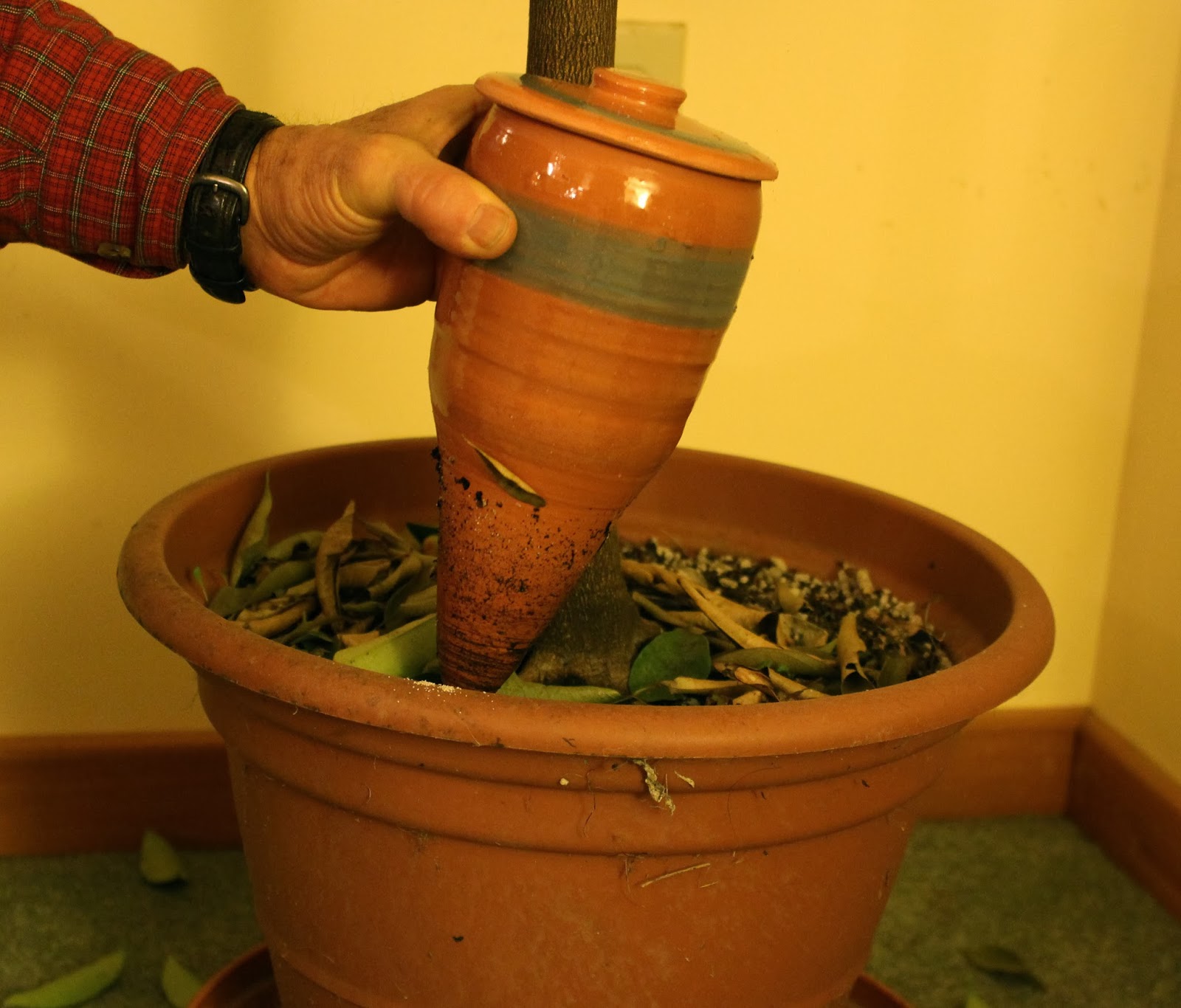
More recently, ceramic marital rewards went further, with the fabrication of an idea I had for an automatic pot watering device, which I’m calling a capillitron. Picture an upside down soda bottle with its bottom end (now up) closed with a removable lid and its top end (now down) tapering to a narrow cone closed off at its end. The whole thing is glazed except for the bottom few inches of tapered cone.

The unglazed portion of the capillatron gets pushed into the soil of a potted plant. The capillatron
reservoir is filled with water, then covered with the lid to prevent evaporation. As the potting soil dries, it draws moisture through the capillary channels of the unglazed, tapered portion of the capillatron, the water in which is continually replaced with the water within the reservoir. The reservoir portion, up out of the soil, is glazed to cut short any capillary migration of water from there to the outside of the pot where it would evaporate.

Within the flower pot, any portion of potting soil that dries will draw moisture from elsewhere in the pot, eventually leading back to right around the capillatron. Theoretically, then, the entire volume of potting soil remains consistently moist as long as the capillatron reservoir holds water. The capillarity within the potting soil, which moves moisture up, down, or sideways, as needed, comes from the organic matter in the mix (compost plus peat moss or coir in mine) and -- you guessed it -- clay in the garden soil that I add to the potting mix.